
Understanding and Using Interval Credit Modes
When analyzing call data in reports separated by time intervals, events (such as calls) can span across multiple intervals. The mode selected determines how these events are credited—either for their count or duration. Below is a breakdown of how each mode handles events for count and duration.
When editing existing or creating a new time interval based report, you'll have the option to define the "Interval Credit Mode". The available options are
- Credit Start Time Interval
- Credit Each Active Interval
- Credit End Time Interval
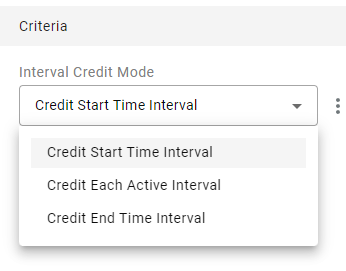
This article is designed to help you understand the differences and which one may be best for your needs.
Count Modes
-
Credit Start Time Interval
- How it works: A row’s count is incremented for each call that starts within the time frame and meets the criteria.
- Key Point: Each call is credited to a single row based solely on its start time.
- Example: A call that starts at 9:59 a.m. and lasts for 10 minutes is counted in the 9:00–10:00 a.m. row, even if it ends in the next interval.
-
Credit Each Active Interval
- How it works: A row’s count is incremented for each call that overlaps with the time frame at any point and meets the criteria.
- Key Point: A call can be credited to multiple rows if it spans multiple intervals.
- Example: A call that starts at 9:59 a.m. and lasts for 10 minutes is counted in both the 9:00–10:00 a.m. and 10:00–11:00 a.m. rows.
-
Credit End Time Interval
- How it works: A row’s count is incremented for each call that ends within the time frame and meets the criteria.
- Key Point: Each call is credited to a single row based solely on its end time.
- Example: A call that starts at 9:59 a.m. and lasts for 10 minutes (ending at 10:09) is counted in the 10:00–11:00 a.m. row, even if it started in the previous interval.
Duration Modes
-
Credit Start Time Interval
- How it works: A row includes the entire duration of each call that starts within the time frame and meets the criteria.
- Key Point: The call duration is credited to a single row based on its start time.
- Example: A 10-minute call that starts at 9:59 a.m. will include all 10 minutes in the 9:00–10:00 a.m.
-
Credit Each Active Interval
- How it works: A row includes the portion of the call duration that overlaps with the time frame and meets the criteria.
- Key Point: A call’s duration can be divided across multiple rows, and the total across all rows will add up to the correct duration.
- Example: A call from 9:50–10:10 a.m. contributes 10 minutes to the 9:00–10:00 a.m. row and 10 minutes to the 10:00–11:00 a.m. row.
-
Credit End Time Interval
- How it works: A row includes the entire duration of each call that ends within the time frame and meets the criteria.
- Key Point: The call duration is credited to a single row based on its end time.
- Example: A 10-minute call that starts at 9:51 and ends at 10:01 a.m. will include all 10 minutes in the 10:00–11:00 a.m. row.
Summary of Differences
| Mode | Count Behavior | Duration Behavior |
|---|---|---|
| Credit Start Interval | Count is credited based on the start time. | Entire duration is credited to the start interval. |
| Credit Each Active | Count is credited to all overlapping intervals. | Duration is split across overlapping intervals proportionally. |
| Credit End Interval | Count is credited based on the end time. | Entire duration is credited to the end interval. |
By understanding these modes, you can choose the one that best aligns with your reporting needs, ensuring data is represented accurately.
Updated 10 months ago